Investor, Not a Trader
I recently listened to Jim Cramer reflect on his career and the path that brought him to where he is today (take a listen on is 8/10/26 podcast). One part of the conversation stayed with me: the distinction between being a trader and being an investor.
When Cramer was younger, he described himself as much more of a trader. That observation resonated with me because I can see the same pattern in my own financial history.
When I was younger, I often traded for the sake of trading. Buying and selling felt like progress. Every transaction created a sense that I was actively managing my money, even when all that activity wasn’t necessarily helping me build wealth.
Today, I approach the market very differently.
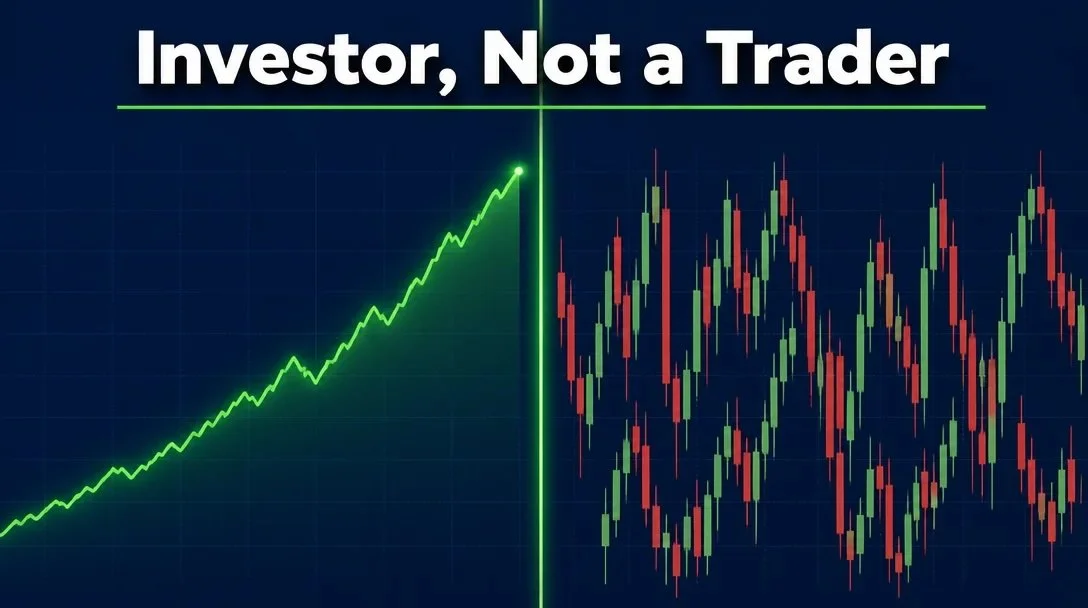
Investing Means Owning a Business
Now, I want to understand the company behind a stock. I want to learn how it makes money, what gives it an advantage, and whether it has a realistic chance of succeeding over the long term.
Once I find a company I believe in, I generally buy and hold. I rarely sell simply because the stock has risen or the market has become nervous. Trust me this takes some guts when there is a large correction.
In fact, my most common regret is no longer, “Why didn’t I sell?” It is, “Why didn’t I buy more?” I use corrections to do this.
Apple is a perfect example. I owned the stock a long time ago and held the stocku until the company reached a market value of roughly $1 trillion. At the time, I sold because I had trouble imagining how it could become much more valuable. There weren’t many $1 trillion companies at the time (maybe Apple was the only one?).
Apple now has crossed the $4 trillion mark. That would be a 400% increase if I would have just kept the stock.
Looking back, my mistake wasn’t necessarily failing to predict a particular stock price. It was allowing a valuation milestone to become my reason for selling a strong business. I was still thinking like a trader, trying to decide whether the stock had gone “high enough” instead of thinking like a long-term owner.
Give Your Trading Instinct Somewhere Else to Go
If I could offer one piece of advice to younger investors, it would be simple:
Be an investor, not a trader.
If you enjoy constant transactions, speculation, and trying to outmaneuver other people, find another outlet for that energy. Play fantasy football. Trade players. Compete with your friends.
Just be careful about satisfying that impulse with your retirement savings.
Frequent trading can feel exciting, but activity should not be confused with progress. Research has repeatedly found that frequent individual trading tends to hurt investment performance, particularly after costs and taxes are considered.
Successful long-term investing is usually much less exciting. It involves choosing an appropriate strategy, contributing consistently, staying diversified, and allowing compounding to do its work.
You Don’t Have to Pick Individual Stocks
You also don’t need to identify the next Apple to become a successful investor.
For many people, especially those who are young and have decades ahead of them a low-cost, diversified index fund or ETF can be an excellent foundation. A fund tracking the S&P 500, such as VOO, provides exposure to hundreds of large American companies. A fund such as QQQ focuses more heavily on large growth and technology-oriented companies, so it is more concentrated and should be understood accordingly.
The answer usually isn’t to collect as many ETFs as possible. Owning numerous funds can create unnecessary complexity and may result in holding many of the same companies several times.
A simpler approach may be more effective:
Choose one or a few diversified, low-cost funds that fit your goals and risk tolerance.
Invest a set amount automatically every month.
Continue contributing through both strong and weak markets.
Leave the money alone and give it time to compound.
Historically, diversified U.S. stock investments have produced strong long-term results, although returns vary considerably and are never guaranteed. Investor.gov notes that some experts use an estimated annual return of approximately 7% to 10% when illustrating the potential long-term growth of diversified U.S. stock investments.
The Lesson I Wish I Had Learned Earlier
If I had consistently invested in a diversified fund when I was younger and kept adding to it instead of moving in and out of stocks I believe I would be substantially further ahead today.
That is the frustrating part of hindsight. We can see the unnecessary trades, the great companies we sold too early, and the years of compounding we missed. I also held some real losers too where I lost a great deal of my investment if not all (ie. WorldCom).
But hindsight can still be valuable if it changes what we do next.
You do not need to predict every market move. You do not need to discover the perfect stock. And you certainly do not need to make a trade every time the market gives you something new to worry about.
Invest in sound businesses or diversified funds. Keep contributing. Be patient.
Let traders worry about what happens tomorrow.
Investors are building for what could happen over the next several decades.